Google September 2026 spam update: the rollout runs up to two weeks
On 24 September Google began rolling out the September 2026 spam update and stated a window of up to two weeks. It is the fourth spam update of 2026 and by far the longest: the previous three finished within 19 hours to a little over two days. We look at why the duration matters more than the content, what the update does not cover, and what to do while it is still running.
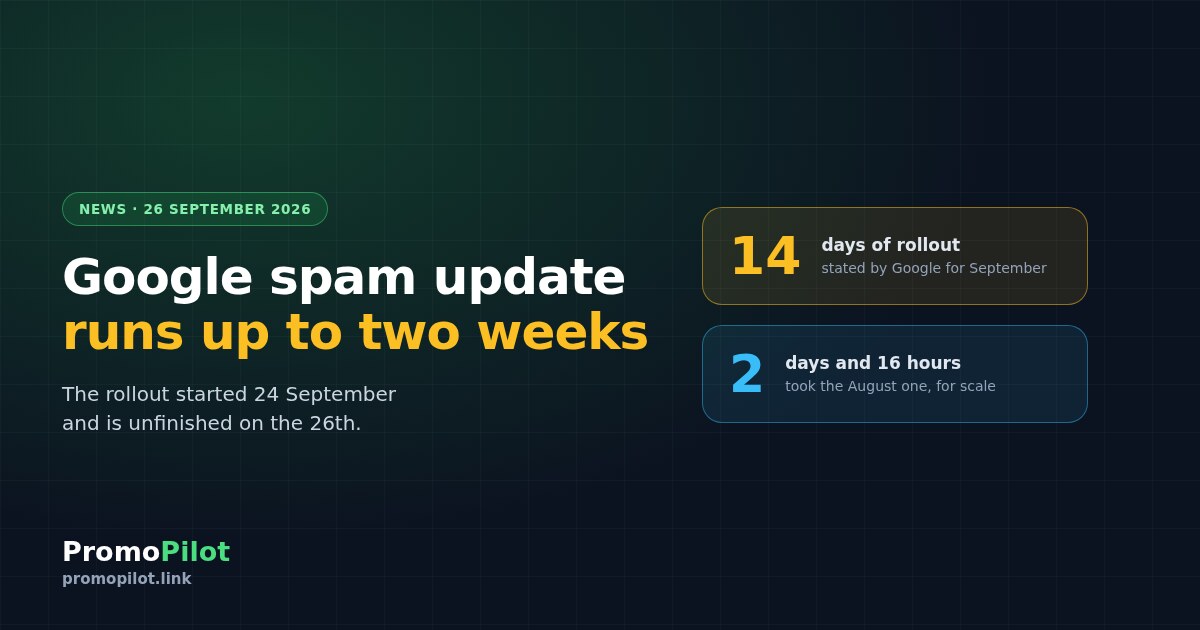
On 24 September Google began rolling out the September 2026 spam update and stated a window of up to two weeks. It is the fourth spam update of 2026 and by far the longest: the previous three finished within 19 hours to a little over two days. While the rollout is still running, any conclusion about rankings is premature — and that is the main practical point of this news.
What Google actually said
The wording on the official Search status dashboard is short and gives no detail:
"Released the September 2026 spam update, which applies globally and to all languages. The rollout may take up to two weeks to complete."
Google Search Status Dashboard, entry dated 24 September 2026So the update is global, it covers all languages, and up to two weeks are allowed for the full rollout. As of 26 September the dashboard shows no completion mark — the process is still going. Google does not disclose what changed inside: as before, this is about strengthening the systems that act on spam policy violations, with no list of specifics.
Why the duration matters more than the content
The difference in timing is not a formality. When a rollout takes a day, the Search Console graph shows a clear step: before and after. When it is stretched over two weeks, changes arrive in waves, and a site can dip, recover, then dip again — all inside a single update. A reading taken on day five will show a picture that no longer exists by day ten.
Hence the practical rule: until the status dashboard marks the rollout complete, interim numbers are good for one thing only — recording dates. Making decisions on them, such as restructuring, rewriting pages or removing links, means reacting to noise.
What this update does not cover
One detail settles the first question everyone working with links asks: the September update does not target link spam. Link signals are handled by separate automated systems at Google, and those work independently of spam updates. The site reputation policy is a separate mechanism too — it was noticeably revised at the end of August, and it is unrelated to this update.
That does not mean links are irrelevant in general. It means that if your traffic changed in the last few days, "it must be the links" is not the first theory to test — it is one of the last.
What to do right now
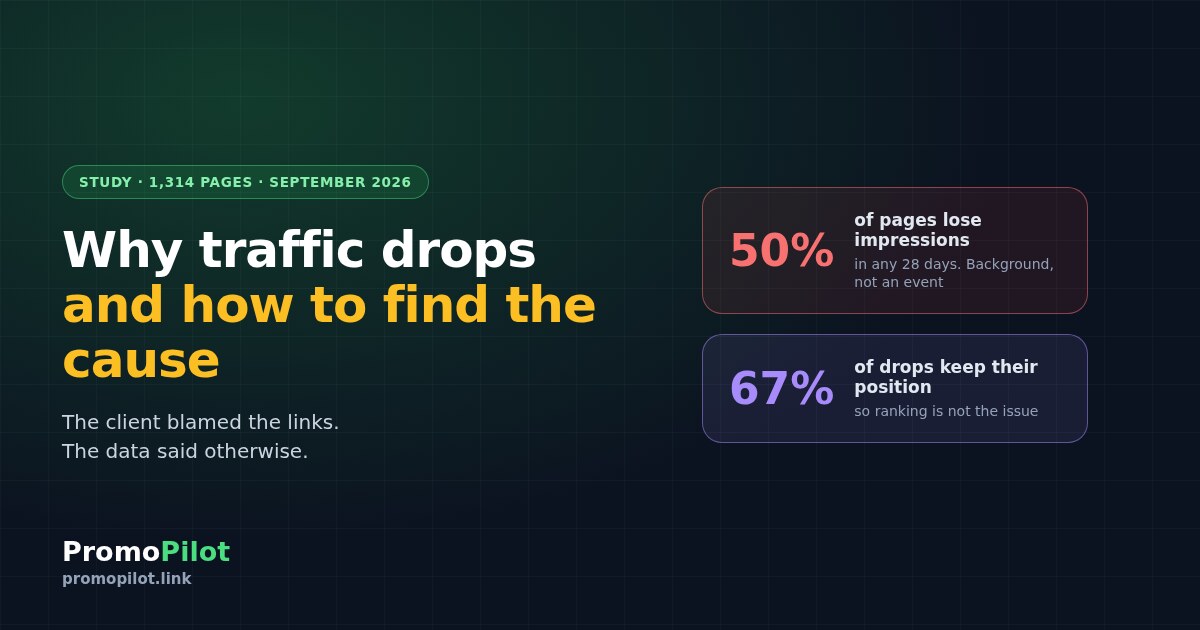
We covered that last point in detail, on our own data, in a new longread: why search traffic drops and how to find the real cause. It contains a figure that is useful precisely now: among pages that lost more than a fifth of their impressions, two thirds did not lose position. An update is far from the only explanation for a drop, and usually not the main one.
What we are doing about it
Spam updates do not change how we work, because our logic rests on measurements rather than guesses about the current algorithm. For every platform in the pool we continuously track the numbers: whether it gets indexed, whether it passes weight, what its own metrics look like — and we recalculate priority from that data. A platform that stops being indexed moves down automatically instead of waiting for a manual decision. The more the results page shifts, the more sense that approach makes: the pool adjusts itself.
Sources: Google's official Search status dashboard (entry "September 2026 spam update", 24 September 2026) and Google's spam policies documentation. Durations of previous updates are taken from the same dashboard.