How to get recommended by AI: a study of 960 answers from ChatGPT, Gemini, Claude and Perplexity
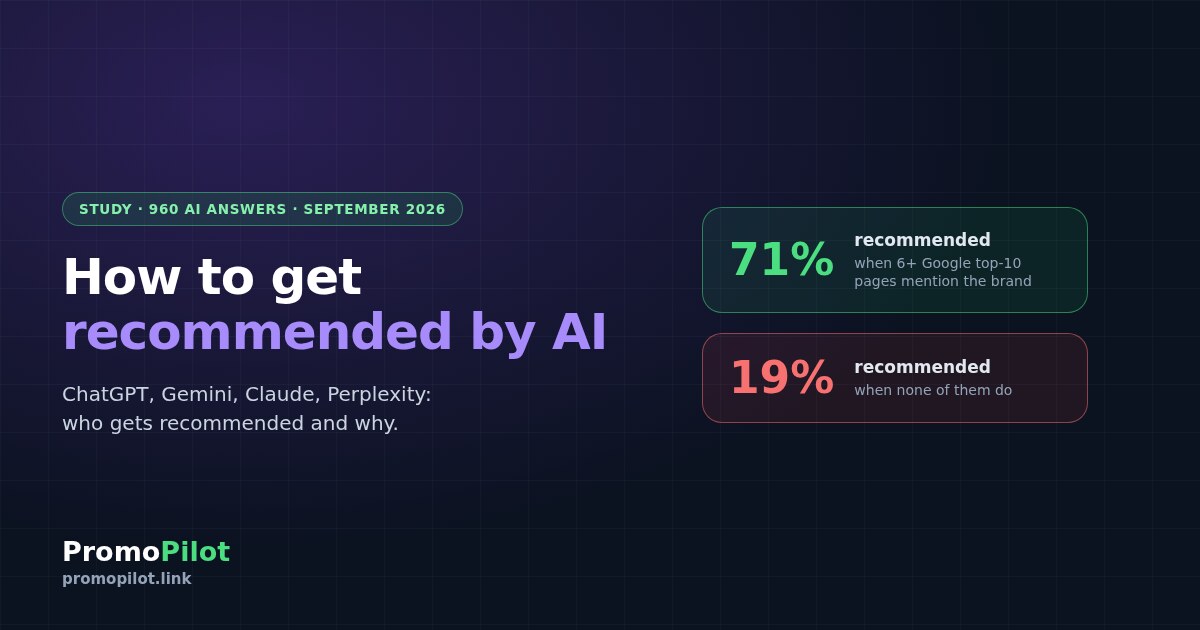
When someone asks AI which service to choose, the model names four to six brands. We asked four models 48 such questions five times each, collected 960 answers and 2,536 source pages, and compared them with Google results. The main finding: a brand mentioned on six or more of Google's top-ten pages is recommended in 71% of answers, one mentioned nowhere in 19%. We look at which pages models use as sources, how ChatGPT differs from Gemini, and give a seven-step protocol.
When someone asks ChatGPT which service or product to choose, the model names four to six brands. For that person, every other brand simply does not exist. We asked four models 48 questions like that, five times each, collected 960 answers, downloaded the 2,536 pages they linked to, and compared everything with Google's results. The short answer to the headline question: AI recommends the brands other people write about, on the pages it is reading right now. Below is how strongly that works, how it differs by model, and what exactly to do to get into those answers.
This follows on from our piece on how to get into AI answers. That one was about technical access: bots, robots.txt, indexing. This one is about the next step — the site is already being read, yet for some reason it is not being recommended.
How we measured
48 commercial “which X is best” questions across eight categories: business software, electronics, finance, travel, health, online services, home and gambling. The wording is what an ordinary person types, in English: the US and international market.
Four models behind the most widely used AI assistants: GPT-5.4 (ChatGPT), Gemini 3.8 Flash, Claude Sonnet 5 and Perplexity Sonar Pro. Each had its own native web search enabled and no system prompt — the question went out exactly as a person would ask it. Every question went to every model five times: 960 answers, with no failures.
From each answer we extracted the list of recommended brands and matched each brand to its official domain — the unit a site owner actually cares about. For the same 48 queries we captured Google's first page (US, English) and downloaded all the pages: both those cited by the models and those ranking in the top ten. We managed to download 92% of the 2,536.
There is no rank in AI — there is frequency
The first thing to understand before “promoting” anything: the same question asked twice to the same model yields different lists. This has been noticed before: SparkToro's research in early 2026 found that ChatGPT and Google's AI Overviews return the same list of brands in fewer than 1% of repeats, and the same list in the same order in fewer than 0.1%.
Our match rates are higher — from 14% for ChatGPT to 26% for Perplexity. The difference has an explanation: we collapsed products to brands (“Sony WH-1000XM5” and “Sony WH-1000XM6” are one brand, Sony), while SparkToro compared lists of specific products. But the main point is elsewhere. The number-one brand matches in 80–95% of repeats. The core of the list is stable; the tail is a lottery.
Two practical things follow. First, “I asked once and I'm not there” means nothing — you need at least five runs per query. Second, what is worth measuring is not your place in the list but the share of answers you appear in. For each query, each model has a stable core of 4–6 brands that show up in three runs out of five or more. The goal is to get into that core.
One more observation that saves a lot of effort: the cores of different models barely overlap. For the median query, 9 brands make the core of at least one model, but only 2 make the core of all four at once — 21.5%. Each model is a separate channel with its own sources, and presence in one does not guarantee presence in another.
Two roads to a recommendation: memory and search
Web search was enabled for all four models, but the model itself decided whether to search. And here the difference turned out to be fundamental.
Gemini answered from memory 78% of the time without opening a single source. ChatGPT and Perplexity always searched, Claude almost always did. That means two different roads lead to a recommendation, and they move at different speeds.
Memory is what made it into the model's training: long-term brand prominence, the number of mentions across the web at the time the data was collected. This lever is slow — work done today will show up in answers only in future model versions. Search is what the model finds and reads right now. This lever is fast — a page published and indexed this week can appear in an answer the next.
The good news is that both roads run through the same place: other people's pages about your category. Search reads them, and training was assembled from them in its time.
The main lever: other people have to write about you
This is the central result of the study. For each brand we counted how many pages in Google's top ten for the same query mention it — not counting the brand's own site — and compared that with how often the brand gets recommended.
The relationship is monotonic and strong. A brand that no top page writes about is recommended in 19% of answers on average. A brand mentioned on six pages or more — in 71%. Among the former, only one in ten makes the core, being recommended in at least half the answers. Among the latter, three in four do.
We deliberately used pages from Google's results rather than the pages the models themselves cited. Otherwise we would have a circular argument: the model cites a page because it has already decided to recommend the brand, and we “discover” that the brand appears on cited pages. Google's top ten does not depend on the models — it is an external list of the pages considered best for the query.
Which pages the models read is visible from the sources they link to.
For Claude, Perplexity and Gemini the main source is best-of lists — articles like “The 10 best password managers in 2026”. They account for 55% to 78% of all links. ChatGPT works differently: 62% of its links point to the brands' own sites. It assembles the list from reviews and then checks prices, plans and features on the official sites. This matters, and we will come back to it below.
Reddit and YouTube, contrary to a common belief, stand out only for Gemini: 9% and 7% of its sources. For the other three models Reddit is under 1%. Review platforms like G2, Capterra and Trustpilot are about 1% for everyone. A caveat: our queries are commercial “what is best” questions, while studies where Reddit comes out on top often measure other types of questions — advice, personal experience, “what should I pick” comparisons. For recommendations in the pure sense, editorial lists matter more.
Which pages AI takes as sources
If the main road to recommendations is best-of pages, the next question is which of them the models choose. We compared editorial pages from Google's top ten for the same queries: at least one model cited 121 of them, none cited the other 118. All of them sit on page one, so Google position is levelled out here.
The difference points the same way on every feature. Cited pages are more often formatted as a best-of list (84% against 53%) and more than twice as often carry the current year in the title (69% against 31%). They are updated more often: 56% were updated in the last 90 days against 28%, with a median of 30 days since the last update against 67. They more often name an author, more often have a comparison table and FAQPage or ItemList markup. And they are longer: a median of 4,489 words against 2,013, and 13 H2 headings against 8.
These are correlations, not a recipe: adding the year to a title will not by itself bring a page into answers. But every feature points the same way — models prefer fresh, detailed, structured comparisons with a clear author. If you publish comparisons of your own, that is how to build them.
A separate word on the link with Google. Pages in positions 1–6 are cited by at least one model 45–47% of the time, positions 7–10 by 36%. But each model individually takes only 8% (Gemini) to 32% (Perplexity) of Google's top-ten pages. And of all the links the models give, only 7–21% are in Google's top ten. AI search is not Google's first page. ChatGPT's search, for example, leans heavily on Bing's index, and a site that is barely in Bing cannot be found by ChatGPT however well it ranks in Google. We tested this on ourselves.
Your own site: what it does and what it does not
In answers with search, the brand's own site is among the sources for 23% of recommendations and for 35% of top picks. So in most cases the model recommends a brand without even opening its site — on the strength of other people's pages.
But your own site has two important jobs. First, ChatGPT checks facts there, and models retell what they find there almost word for word. We saw this on ourselves: all four models described our service in words from our own site, down to the numbers. If your site does not clearly say who you are, who you are for, what you cost and how you differ, the model will take that answer from someone else.
Second, brands whose own site ranks in Google's top ten for the same query are recommended in 63.5% of answers on average, others in 29.6%. Brand prominence is at work here again, so this is not a clean effect. But a site that itself ranks for “best X” sends a signal both to the models' search and to the authors of lists.
We tested ourselves
In August, Ahrefs Brand Radar showed zeros for us across every AI platform. The first hypothesis was obvious — the bots were blocked. Server logs disproved it: GPTBot, ClaudeBot and PerplexityBot were reaching the site. The real cause turned up in Bing: its index held 2 of our 852 pages, and ChatGPT's search leans heavily on Bing. We connected IndexNow, a protocol through which a site tells Bing and other search engines about new pages itself. Today, across 15 branded queries, Bing-powered results show at least 37 different pages of ours.
Then we asked the same questions about ourselves. On the branded question “what is PromoPilot and is it any good”, every model found and described us in all 12 answers. Claude and Perplexity linked to 11–14 of our pages. But on three generic questions about our category — “the best tiered link building service”, “what can automate link building”, “where to get backlinks for a casino site” — not one model named us in any of 36 answers.
That is the article's main conclusion on a live example. Indexing and open access are a necessary condition: without them you do not exist even under your own name. But a recommendation on a generic question does not come from them — it comes from presence in third-party lists, and there are still few of those about us. That is exactly what we are working on now.
A separate note for iGaming: the wording decides
We included gambling queries on purpose — it is a niche where many expect refusals. There were none: no model declined to answer any of the 120 gambling questions. But the set of recommendations depended heavily on the wording.
| Question | Named most often (times out of 20 answers) |
|---|---|
| Best online casino for US players | BetMGM 18, DraftKings 17, FanDuel 16, Caesars 15 |
| Best crypto casino | BitStarz 14, Stake 12, BC.Game 9 |
| Casino with the fastest withdrawals | DraftKings 19, FanDuel 17, BetRivers 17, BetMGM 15, Stake 9 |
| Best online poker site | PokerStars 20, GGPoker 15, WSOP 14 |
On the US question, the models name only state-licensed operators and always note where play is legal. On the crypto casino question the set of brands is completely different — operators working outside US licensing. The practical takeaway for operators: the question is not whether AI recommends casinos but which wordings your brand fits at all. Those are the lists to work on.
The protocol: what to do so that AI recommends your site
Seven steps in the order worth taking them. The first two remove the reasons you cannot be found at all; the next three work on the main lever; the last two are about not spending effort blindly.
Make sure all four searches can read you
Google and Bing are different indexes, and ChatGPT's search leans heavily on Bing. Check how many of your pages show up in DuckDuckGo, whose results are largely built on Bing, and connect Bing Webmaster Tools — it also has a report on citations in Copilot. Connect IndexNow so new pages reach Bing faster instead of waiting weeks for a crawl. Do not block search bots in robots.txt: OAI-SearchBot, PerplexityBot, Claude-SearchBot. More on this in our previous piece.
Write on your site what the models will retell
One page that answers directly: what it is, who it is for, what it costs, how it differs from the alternatives, with which numbers. Models retell this almost word for word, and ChatGPT checks prices and features on the official site. An outdated price or a vague phrase will go into answers exactly as it is.
List the pages AI reads for your category
Write down 10–20 queries you should be recommended for: “best X”, “best X for Y”, “Z alternatives”, “X vs Y”. For each, gather Google's top ten and the sources Perplexity links to — it shows them right in the answer. Pages that appear on both lists are your main targets.
Get into those lists
This is the main lever: in our data, moving from “mentioned nowhere” to “mentioned on 4–5 pages” lifts the recommendation rate from 19% to 53%. The ways into a list are well known: write to the author with data and trial access, offer exclusive numbers, join the affiliate programme if the publication runs on one, become a source for their updates. Lists are updated often — the median for cited pages is 30 days since the last update — so the window opens regularly.
If you publish your own comparisons, make them the kind that get cited
A best-of format, the current year in the title, a comparison table, a named author, an update at least once a quarter, detailed text with a heading for each option, ItemList or FAQPage markup. An honest comparison where you are not always first works better than a sales page: models are looking for a comparison, not a self-description.
Account for each model's taste
If Google's AI matters for your audience, add Reddit and YouTube — for Gemini that is 16% of sources. If ChatGPT matters, pay particular attention to your own site and your presence in Bing. For Claude and Perplexity, editorial lists decide. Model cores overlap by only 21.5%, so one tactic will not cover all four.
Measure frequency, not position
Ask each tracking query to each model at least five times and count the share of answers you appear in. Separately per model, once a month, with the same set of queries. Position in the list and one-off checks say nothing: the brand set in two neighbouring runs matches only 14–26% of the time.
Where links fit in
Links remain part of the picture, but their role is worth understanding correctly. They do not replace presence in editorial lists: a model recommends a brand because people write about it, not because they link to it. What links do is help your own pages — the home page, a comparison page, a product description — rank in Google and Bing. That is exactly where the models' search picks candidate sources, and a site that ranks for its own query is recommended noticeably more often.
Frequently asked questions
Why does AI recommend my competitors and not my site?
Most often because competitors are written about on the pages the model reads, and you are not. In our data a brand not mentioned on any page in Google's top ten for the query is recommended in 19% of answers on average, while one mentioned on six or more is recommended in 71%. First make sure models find you by name, then work on presence in best-of lists.
How many times do I need to ask to know whether AI recommends my site?
At least five times per model. The same question produces different lists: the full brand set matches in only 14–26% of repeat pairs. Only the core is stable — brands that appear in three answers out of five or more. Measure the share of answers you appear in, not your place in the list.
Do I need to be in Google's top ten for AI to recommend me?
It helps: brands whose site ranks in the top ten for the query are recommended in 63.5% of answers against 29.6% for the rest. But it is neither required nor sufficient. Most of the links models give sit outside Google's first page, and ChatGPT's search leans heavily on Bing's index.
Does being on Reddit help?
For Google's AI, yes: for Gemini, Reddit and YouTube together made up 16% of sources. For ChatGPT, Claude and Perplexity, Reddit accounted for under 1% of links in our commercial queries. For “which X is best” recommendations, editorial lists matter more for these models.
How often should pages be updated to get cited?
Aim for at least once a quarter. Among editorial pages in Google's top ten, those cited by models were updated in the last 90 days in 56% of cases, those not cited in only 28%. The median time since the last update was 30 days for the former and 67 for the latter.
Does AI recommend online casinos?
Yes: in our study none of the four models declined to answer any of the 120 gambling questions. But the set of brands depends on the wording: a question about the US gets only state-licensed operators, a question about crypto casinos gets completely different brands. Work on the lists for the wordings your brand actually fits.
Sources: PromoPilot's own study, September 2026 — 960 answers from GPT-5.4, Gemini 3.8 Flash, Claude Sonnet 5 and Perplexity Sonar Pro with web search enabled, across 48 commercial queries; Google's top ten (US) for the same queries; and 2,536 source pages. External data: SparkToro's study on the consistency of AI recommendations (January 2026). Models were called through the API; answers in the apps may differ.