Google changed the site reputation policy: the penalty now depends on where the searcher is
The end of August brought two confirmed events for anyone placing content and links on other people's domains. Google adjusted enforcement of its site reputation policy: from 30 August a manual action applies outside the EEA and not inside it, while the affected section may be separated in Google's systems. The August spam update also rolled out. We break it down from primary sources and list what to check on your own site.
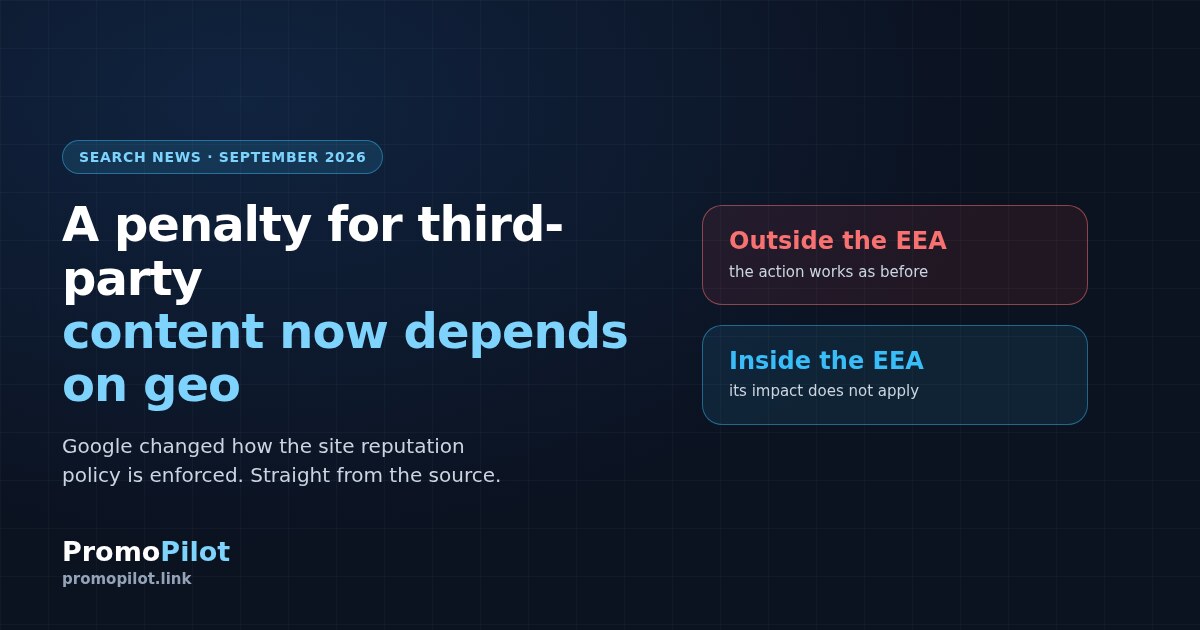
The end of August brought two confirmed events that concern anyone placing links and content on other people's domains. Google changed how its site reputation policy is enforced — the same manual action now works differently depending on where the searcher is. On top of that, another spam update rolled out. Here is the breakdown, from primary sources rather than retellings.
What changed in the site reputation policy
On 28 August the Google Search Quality team published an update. A reminder of what the policy is about: it covers the situation where third-party content is published on a trusted site in order to borrow that site's reputation and rank higher.
"In 2024, we introduced our site reputation policy to stop a practice where third-party content is published on a trusted website just to exploit that site's good reputation to rank higher in Search."
"Following discussion with the European Commission, we are adjusting our enforcement approach within the European Economic Area (EEA) and clarifying the criteria we consider when applying the policy."
Google Search Central Blog, 28 August 2026The substance of the change is geographic. From 30 August a manual action under this policy no longer works the same way for everyone:
Google spells out separately what this means for pages read all over the world:
"Because many pages are viewed by people globally, it's possible that any given page might have a manual action taken on it, but that change will only affect search results shown to users outside the EEA."
Google Search Central Blog, 28 August 2026Manual actions are still reported in Search Console. If you believe one was applied in error you can file a reconsideration request — and eligible sites now get the opportunity to bring the dispute to mediation afterwards. That last part is new.
What it means in practice
For anyone buying placements on trusted domains this matters more than it looks. The risk used to be the same for everybody. Now it is asymmetric: the action hits results outside the EEA and does not apply inside it. If your main market is the United States, the United Kingdom or any country outside the EEA, nothing has been softened for you. If your audience is European, the direct effect will not reach you — but the affected section of the host may be separated in Google's systems and, over time, start ranking on its own, apart from the rest of the site.
The second event: the August spam update
According to Google's own status dashboard, the spam update started on 18 August and took 2 days and 16 hours to roll out. It is the third confirmed spam update of 2026, after the ones in March and June.
Worth keeping separate in your head: spam updates and the site reputation policy are different mechanisms. The first works automatically; the second runs through a manual action with a notification in Search Console. If rankings dropped and no notification arrived, a manual action is not the cause.
What Google says about paid links
Nothing has changed here, but the wording is worth rereading — especially against the background of talk that "links no longer work". Google classifies as link spam the buying and selling of links for ranking purposes, exchanging money for links or for posts containing links, and exchanging goods or services for links. And immediately adds:
"It's not a violation of our policies to have such links as long as they are qualified with a rel="nofollow" or rel="sponsored" attribute value to the <a> tag."
In other words the rel attribute is not a formality or a technical detail but the line between complying with the policy and breaking it. Which is precisely why it matters to know what is actually there.
We checked this recently across 27 platforms and got an uncomfortable result: on one in seven, checking the page source gives the wrong answer, because scripts rewrite the markup — stripping the attribute in some places, adding it in others, and in one case creating the link itself. What you need to look at is the rendered DOM, the page as the search engine receives it.
How this relates to what we do
The site reputation policy describes a specific pattern: third-party content on a site that earned its trust with its own content. That is the whole complaint — a reputation is borrowed that the placed material has nothing to do with.
A cascade works differently: publications go to platforms whose entire purpose is publishing user content. Such a platform has no editorial reputation of its own to borrow. That is not a guarantee and not a free pass — but the pattern the policy describes is built differently.
What we do on our side: every platform's priority in the system is recalculated from its actual performance rather than set once and for all. Indexing of publications, confirmed weight passing (checked precisely in the rendered DOM) and domain metrics all feed into it. A platform whose indexing has dropped, or which has started closing its links, sinks automatically, without anyone deciding it should. The ones that end up on top are those performing best on current data.
What to check on your own site this week
- Open Search Console and confirm there are no manual action notifications. It takes a minute, and an unnoticed action can sit there for months.
- If you have bought placements on other people's domains, look at what those sections are. A guest section living separately from the site's own content deserves attention.
- Check the
relon your links in the rendered DOM rather than in the page source. The discrepancy is more common than people assume. - If your main market is outside the EEA, remember that the softened enforcement does not apply to you.
The crawl reports the technical problems that keep pages out of the index.
Sources
Google Search Central Blog, "Update to the Site Reputation Policy", 28 August 2026: the enforcement adjustment in the EEA, the dates, the reconsideration and mediation process.
Google Search Central, "Spam policies": the definitions of site reputation abuse and link spam, and the condition regarding rel="nofollow" and rel="sponsored".
Google Search Status Dashboard: the August 2026 spam update, started 18 August, duration 2 days 16 hours.
PromoPilot's own measurement, 11 September 2026: 27 platforms, page source compared with the rendered DOM.